GLADESVILLE BRIDGE
& the Drummoyne to Lane Cove section of the North Western Freeway
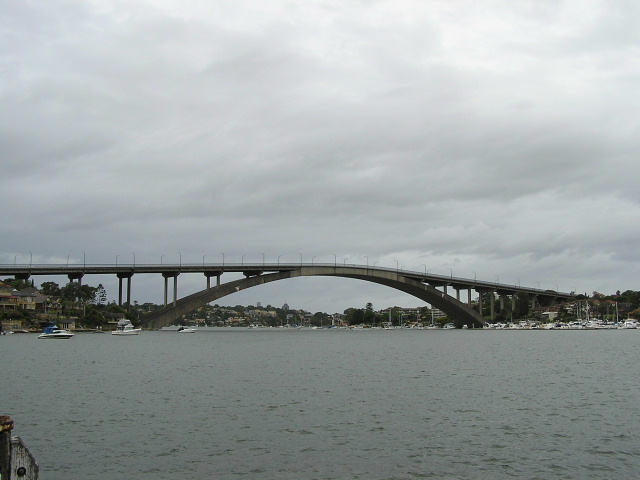
The Gladesville Bridge is located midway along Victoria Road, 8km from the CBD, crossing the Parramatta River. Combined with the Burns Bay Road bridges over Tarban Creek and Lane Cove River (Fig Tree Bridge), the Gladesville Bridge makes up the only stage of the North Western Expressway to ever be constructed. This expressway was to be part of the F3 Freeway, taking traffic from Sydney CBD to Newcastle and beyond.
The complex of bridges and roads that make up this section of freeway were fully opened to traffic in December 1965 and received several awards for its design and environmental management. The project consisted of a 1.7km deviation of Victoria Road from Westbourne Street, Drummoyne to Crown Street, Henley; a new, high-level bridge across the Parramatta River; a grade separated interchange where Victoria Road meets Burns Bay Rd; a bridge over Tarban Creek; a grade-separated interchange at Church Street, Hunters Hill and a new bridge over the Lane Cove River at Linley Point.
This section of road and bridge was considered an expressway until the cancellation of the North Western and Lane Cove Valley Expressways in the late 1970s. 'End of Freeway Conditions' signs still survived at either end of this section for many years until the one on Burns Bay Road was removed in 2002. Some signs for pedestrians advising them of how to cross the expressway still exist to this day at the Hunters Hill Interchange.
History and Construction:
The first crossing of the Parramatta River in this area was on the Great North Road at Abbottsford, where a punt, established in 1832, took travelers across the river to Bedlam Point. Increased traffic to the Ryde and Lane Cove areas demanded a permanent river crossing and finally construction was begun on a new route from the City to the west. In April 1878, construction of the Iron Cove, Gladesville and Fig Tree Bridges was commenced. All 3 bridges were iron truss bridges, with the Gladesville Bridge having a swing-span for opening to river traffic. Twelve months later, construction was suspended on the Iron Cove Bridge to concentrate on the Gladesville and Fig Tree Bridges. Opened to traffic in February 1881, the Gladesville Bridge provided the only bridge across the Parramatta River or Port Jackson east of Parramatta. The Iron Cove and Fig Tree bridges opened in November 1882 and 1885 respectively to complete the new route. There was no crossing of Tarban Creek, however, and traffic between Gladesville and Fig Tree Bridges had to use Gladesville Rd and pass through Hunters Hill.
About 20 years after its opening, tram tracks were installed in Gladesville Bridge for the route to Gladesville (later extended to Ryde). The trams would prove to be an increasing source of congestion as the years passed. At one stage prior to the construction of the new bridge, the Gladesville Bridge was operating in peak periods as a one-way river crossing and traffic had to be halted completely for trams traveling in the opposing direction to cross the bridge safely. Normal traffic opposing the one-way flow in peak times was advised to cross the river via either the Ryde or Sydney Harbour Bridges.
Immediately following WW2 construction commenced on a replacement for the two-lane Iron Cove Bridge (February 1946) but due to a shortage of steel, construction was delayed for a number of months. The replacement bridge, still in use today, was opened to traffic in 1955. The bridge is a four-lane steel truss structure and since its opening, a fifth lane has been constructed as a bailey bridge on the southern side.
The construction of a new Iron Cove Bridge was found to be a rather short-sighted venture when the proposed North Western Freeway was unveiled in 1951 as part of the County of Cumberland Planning Scheme. This freeway would follow closely the line of Victoria Rd between the Gladesville and Glebe Island Bridges. Detailed design commenced quite swiftly on the first section of this freeway which would also double as a replacement to the out-of-date Gladesville and Fig Tree Bridges. Construction on the Gladesville Bridge commenced in December 1959 and the Fig Tree Bridge was commenced not long after. A key part of this section of freeway that is often forgotten is the Tarban Creek Bridge which connects the Gladesville and Fig Tree Bridges, eliminating the circuitous route via Victoria and Gladesville Roads.
The Fig Tree Bridge was the first of the new bridges to open, in September 1963, along with new north-facing ramps at Church Street, Hunters Hill. The second stage to open was the centre piece of the project, the Gladesville Bridge. Opened to traffic in October 1964, along with a new deviation of Victoria Rd along the northern perimeter of Riverside Girls High School, it was the longest concrete arch span in the world at 1,000 feet. A clearance of 134 feet above mean water height was provided at the centre of the arch. The final link in this project, the Tarban Creek Bridge, was opened to traffic in December 1965. The completed project provides complete uninterrupted flow of traffic between Burns Bay Rd at Lane Cove; and Victoria Rd at Drummoyne and Gladesville.
As with all major urban road projects, the construction of the Gladesville, Fig Tree and Tarban Creek bridges was not without its impacts. To locate the expressway alongside Joubert Street in Hunters Hill, one of the least built up parts of the suburb, several significant buildings had to be demolished, inlcuding St Malo, Mary Reiby's House and St Mark's Chapel. Greg Davis has researched and written an excellent article on the battle to save St Malo, which you can find HERE (warning - file is 10MB).
Since its opening, further sections of the North Western and Lane Cove Valley Freeways have been permanently cancelled and this complex of roads and bridges remains a mere shadow of what it could have been. Not much has happened in the way of change, so much that original 1964 signs and structures still remain on some parts, except the deck of the Gladesville Bridge was widened by narrowing the southern footway to make room for a seventh lane.
-
Click HERE to view the interactive map of the Gladesville Bridge and the associated section of freeway
-
Click HERE to view photographs of Gladesville Bridge and the associated section of freeway
-
Click HERE to discover more about the planned (but never built) North Western & Lane Cove Valley Expressways
Gladesville Bridge Info |
Freeway Info |
Roadway name: Victoria Road |
Roadway names: Victoria Road, Burns Bay Road |
Length (arch span): 330m (1000 feet) |
Length: 2.5km |
Route numbers: A40 (2013-) |
Route numbers: A40 (2013-) |
Former route numbers: |
Former route numbers: State Route 40 (1974-2013) State Route 21 (1974-2004) |
Opened to traffic: October 1964 |
Opened to traffic: Fully opened in December 1965 |
Last updated 18 October 2013 © Ozroads 2003-2013.. |